Note
There’s room for AI at the table
We can each develop an idea with our own AI. We can also create places where those ideas meet and change.
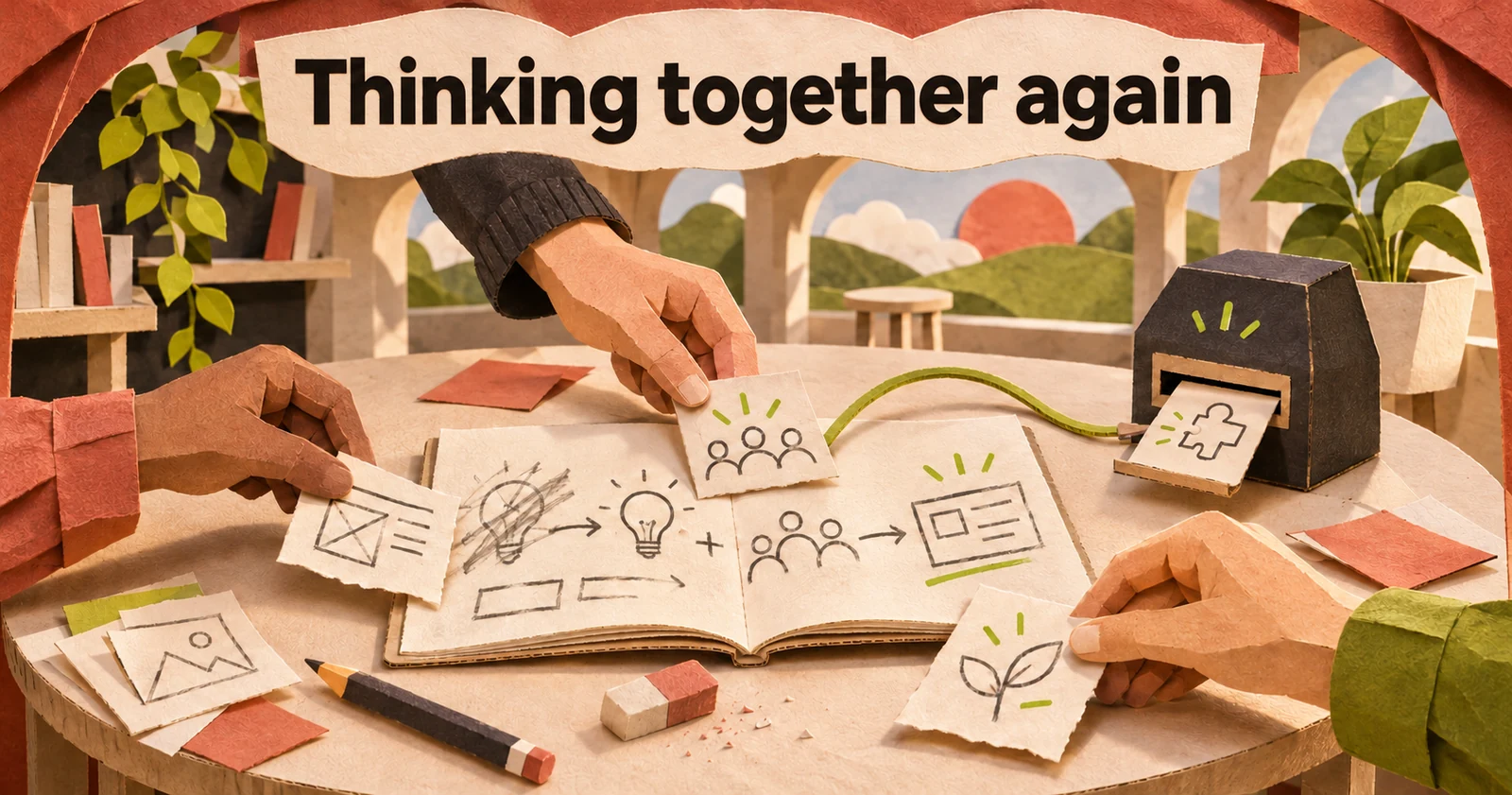
Picture two or three people working on a campaign. Each can arrive with an idea developed with their own assistant. They still have to find out what happens when they share it and someone else changes it.
They could continue the conversation with those assistants present. Or try a shared AI that helps organise what comes up. They could combine both approaches too. The group would have to find out what helps at each point.
In the creative team studied by RSM (opens in a new tab), steps that had involved different disciplines became concentrated in an exchange between one person and the tool. There were fewer handovers, and fewer opportunities for someone to offer another interpretation.
Letting ideas cross paths again
Working independently has real value: you can take an intuition further before asking for help. There is also something worth preserving in the moment when someone hears a half-formed idea and sees a way forward you had not considered.
At our imagined table, one person proposes a scene and someone else reads it differently. AI could make a variation that everyone can see and discuss. The exchange stays between people; the tool participates without having to settle every disagreement.
A conversation like this may include differences of opinion or a drawing someone does not understand. Some of that friction can help people think: something emerges that was missing from the original proposal. It is worth making room for when it opens a possibility or changes a decision.
In the P&G experiment (opens in a new tab), people working with AI produced proposals comparable in quality to those from teams without AI. Their proposals also brought technical and commercial perspectives together more effectively. That opens a possibility: a tool can bring previously separate perspectives closer. How to use that in a creative conversation among several people is something we would still need to try.
Sharing what is still undecided
A shared context could start simply: what we want to achieve, what we ruled out and why, and what remains uncertain. AI can help organise that record and suggest connections. People need to be able to correct it, even when the summary sounds convincing.
A question shared well can be more useful than three finished answers.
Sharing context does not mean handing over every private conversation. We can choose what the project needs and make clear who can see it. What matters is that someone else can enter the reasoning and change its direction.
We could start with a half-formed idea and keep talking together, with AI at hand. See what happens when someone takes it somewhere we had not considered.
Sources
The meeting and the proposal for shared context are imagined possibilities, not a method validated by these studies. RSM describes an ethnographic study of one creative team; the P&G experiment involved 776 professionals working on product development. Original and institutional summaries were consulted, not the full papers. The scenes are not personal anecdotes.