Note
An image can look finished before the idea is ready
Could a rough sketch still have something to offer?
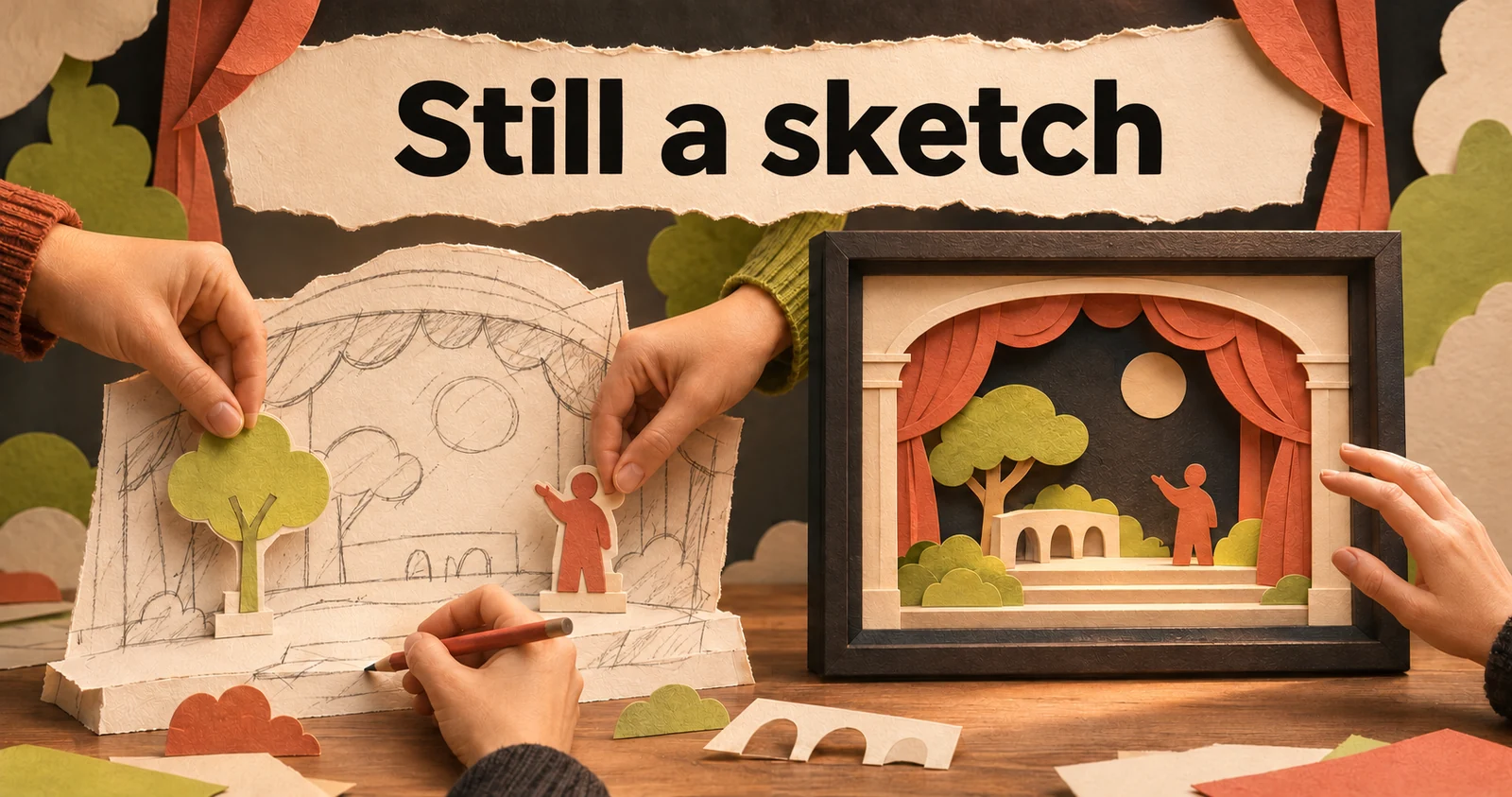
Imagine a meeting to work on a campaign. There are three rough sketches on the table. Someone moves a character; someone else suggests a different setting. The drawings are unfinished, and it is still easy to make changes.
Now replace those drawings with an image where the lighting, wardrobe and location all look ready to shoot. The conversation might drift towards the colour of a wall. The underlying idea still needs work, but its appearance has become hard to let go of.
Research with a creative team (opens in a new tab) at RTL Nederland describes this shift. Retkowsky, Huysman and Hafermalz call it early aesthetic closure: a generated image looks complete and starts to define what the client expects to receive.
What a rough sketch leaves open
A quick drawing lets people imagine things that are not there yet. Each person fills in something different and can say so before one version becomes everyone’s reference. Leaving things undefined gives other people room to contribute.
That friction can have a purpose: giving us time to explain the drawing, hear another reading and decide what to try. Leaving something open makes room for that exchange. If it only adds waiting without helping us think, it loses its point.
A generated image can be a great way to explore a mood or test a direction. Trouble starts when its visual choices become project decisions. The tool picked a window. Nobody discussed whether the scene needed one.
Someone may then have to produce something that only worked inside that image. The study describes additional work to bring real production closer to a reference that has already been accepted. That takes skill and time too.
Deciding how much to resolve
We could first bring a few lines describing the situation, or a sketch. Discuss what happens to the character, what we want to say and what is not working yet. Then ask AI for an image to explore that idea.
We can also show a highly developed image and point out where we want people to intervene: the lighting is a test; the setting is still open. That openness needs to exist in the conversation and in our willingness to change the image.
An image can be finished while the idea still needs work.
We could bring that sketch to the next meeting and hear what everyone sees in it. Leave some time to talk it through before deciding what it should look like.
Sources
The meeting is an imagined scene. The sources consulted were RSM’s institutional account and the original abstract of an ethnographic study of a creative team at RTL Nederland. The full journal article was not accessible. The suggestions for presenting sketches are editorial proposals, not a protocol tested by that research.